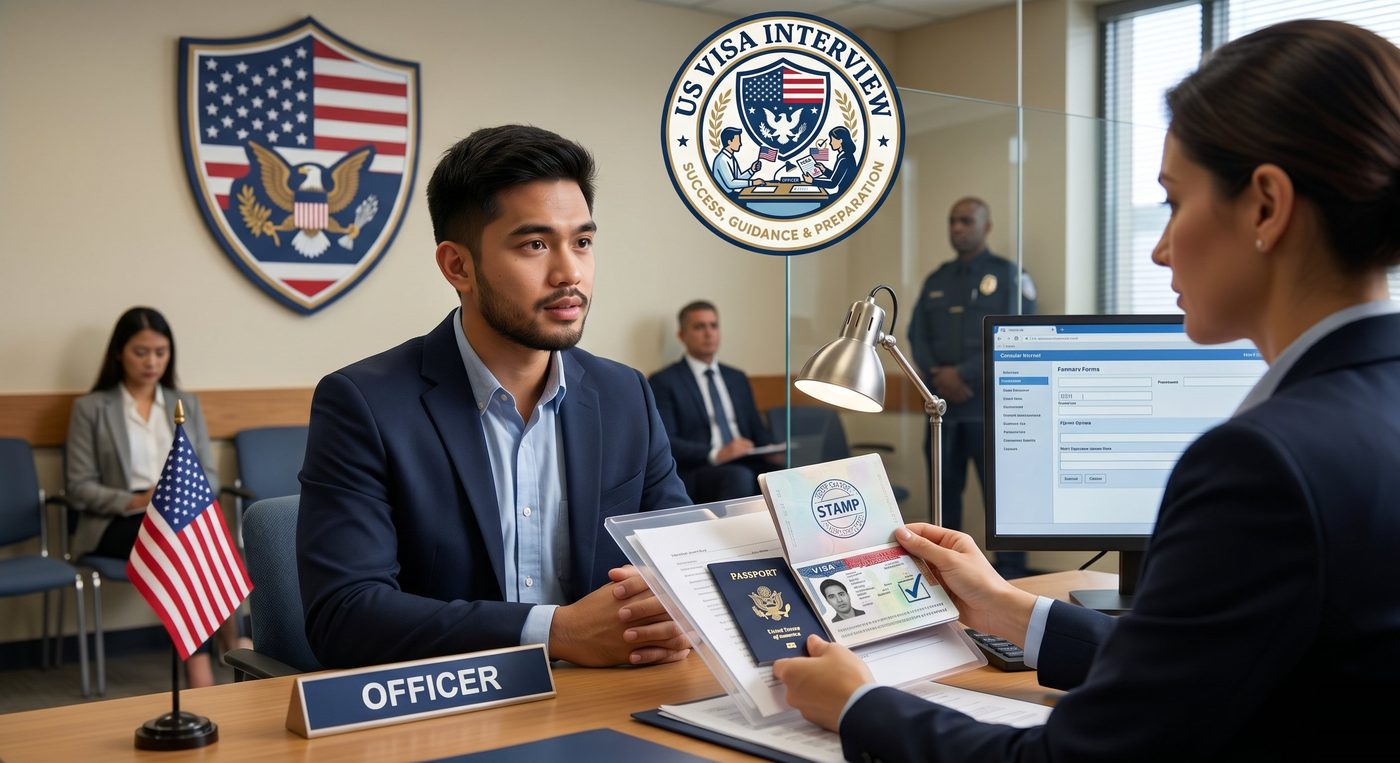
Most refusals happen in the first 60 seconds — not over paperwork, but over how you answer. Practice with a realistic AI consular officer until your answers come out calm, clear, and convincing.
Practice by video or voice · Scored feedback after every session · Works for B1/B2, F1, J1, and more
The US government presumes every applicant intends to immigrate — and it's on you to prove otherwise, out loud, in a conversation that's over before most people settle their nerves. Even applicants with excellent profiles are refused for answering vaguely or hesitating under pressure.
Officers often decide within the first minute. There's no time to warm up — your opening answers carry the whole case.
Under Section 214(b), you're presumed an intending immigrant until you prove strong ties to home. The officer doesn't have to be convinced — you have to convince them.
Most refusals come from weak or generic answers, not missing paperwork. How you say it matters as much as what you say.
Video for the full face-to-face pressure, or voice-only to rehearse your answers.
Answer real 214(b)-style questions out loud, in a 3–5 minute interview that mirrors the embassy.
A 0–100 assessment with your strengths, red flags, and the one tip that matters most.
Repeat until your answers are calm and convincing. Repetition is how nerves disappear.

The questions are predictable. Your nerves are not — until you've answered them out loud enough times that the answers come automatically. Here's what changes when you practice first.
“Why this university?” — and you ramble about rankings, unsure, eyes down.
A 15-second answer that connects the program to your plan back home — calm, specific, convincing.
“What ties you to your home country?” — you freeze, because no one ever asked you to say it out loud.
You name your job, family, and reason to return without hesitating — the exact thing 214(b) is testing for.
The officer's first question catches you off guard and the nerves take over for the rest of the minute that decides it.
You've already heard that question five times. You answer steadily, and the scored feedback told you exactly what to fix.
These examples illustrate how practice helps you prepare. They are not customer testimonials, and practice does not guarantee a visa outcome.
One-time purchase. Your access code is emailed the moment you pay. Each interview mirrors the real 3–5 minute embassy experience — practice as many times as your package allows.
Secure checkout by Stripe or PayPal. Your code is sent to your email instantly.
No. This is an independent preparation tool. It is not affiliated with the U.S. Department of State, and a good practice score does not guarantee a real visa outcome — it helps you walk in prepared.
The officer asks 214(b)-style questions that apply across nonimmigrant categories — B1/B2 visitor, F1/J1 student and exchange, work visas, and more. You can steer the conversation toward your situation.
Video puts you face-to-face with the AI officer for the full pressure of the window. Voice-only lets you rehearse your answers more lightly. Both give you scored feedback.
Your access code is emailed instantly. Enter your email and code on the practice page to begin. Each code is good for the number of interviews in your package.
About 3–5 minutes — the same as a real embassy interview. Short, focused, and high-pressure on purpose, because that's what you're preparing for.